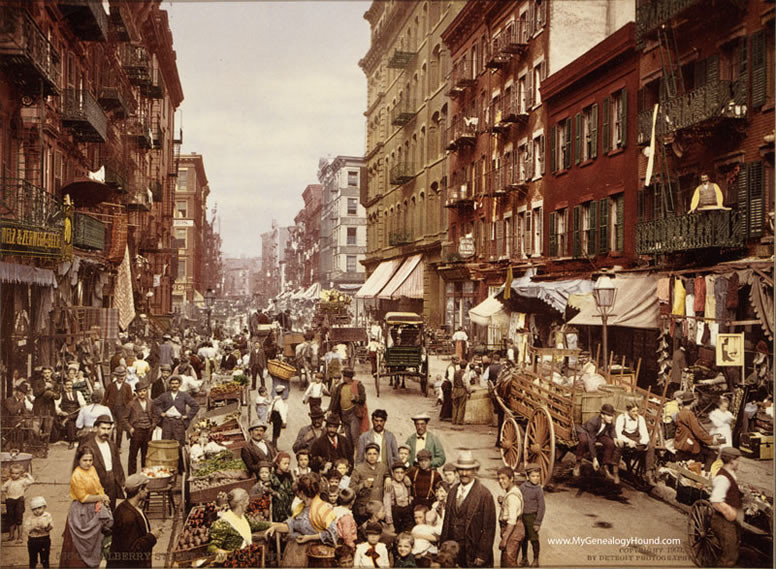


Markets, pushcarts, and storefronts shaped how people moved through the city, turning sidewalks into spaces of exchange.
Many street vendors operated directly from sidewalks and curb edges. Pushcarts lined narrow blocks, their goods arranged for maximum visibility. In these photographs, commerce is inseparable from movement: customers pass through, shop around, negotiate, and continue on.

Vendors stand close to their goods. Buyers move within arm’s reach. Space is shared, contested, and reused throughout the day. These scenes reveal how selling depended less on fixed infrastructure and more on adaptability.

What stands out in these photographs is how informal much of this commerce appears. Markets occupy intersections, doorways, and temporary stalls.
Street vending functioned as a practical response to the economic and spatial realities of urban life. Selling outdoors required far less capital than maintaining a permanent storefront, making commerce accessible to individuals and families with limited resources. A cart, a table, or a temporary stall was often enough to begin.
The street also offered immediate access to customers. Dense foot traffic meant goods could be displayed directly in the path of daily movement, eliminating the need for signage or advertising. For sellers of perishable items, visibility and speed mattered more than permanence.

Outdoor selling allowed for flexibility. Vendors adapted to changing conditions—weather, crowd flow, enforcement, demand—using space that was temporary rather than fixed.

Lower East Side, ca. 1890s. Department of Street Cleaning Collection, NYC Municipal Archives.